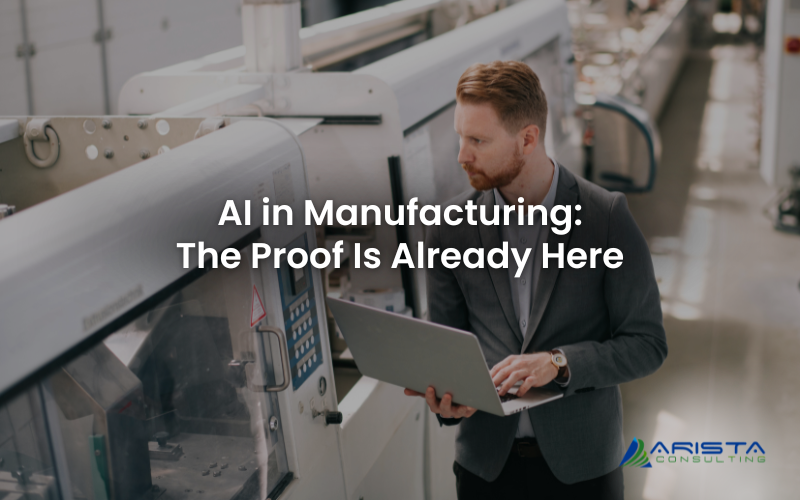
AI in manufacturing today is embedded, agentic AI that analyzes operational data, recommends the next best action, and executes routine work inside the systems a plant already runs. Rather than a standalone tool or an experiment running beside the business, it operates within procurement, quality, production, and supply chain workflows, turning data the business already generates into decisions and actions in real time. The clearest example is QAD’s agentic AI, which embeds Champion agents directly into manufacturing workflows so the system doesn’t just report what happened, it helps run what happens next.
For years, AI in manufacturing lived in the future tense. It was a roadmap item, a keynote topic, a pilot in a corner of one plant. That era is over.
AI is now operating in live manufacturing environments and delivering measurable results across procurement, production, quality, and supply chain operations. The center of gravity has shifted from concepts and roadmaps to execution and outcomes. That shift matters because it changes the stakes of waiting. When AI was theoretical, sitting out the hype was prudent. Now that it is running in real plants and showing up in real results, standing still has a cost, and the manufacturers who move first are the ones setting the pace.
If AI is already working, why isn’t everyone using it? The honest answer is usually not technical. It is fear, uncertainty, and doubt, reinforced by a specific and understandable assumption: that adopting AI means another slow, costly, disruptive program like the last ERP migration.
For years, that assumption was fair. Upgrades were painful enough that most manufacturers stayed put, layering customizations onto existing systems rather than taking on another large project. Agentic AI changes the math. Instead of a rip-and-replace program, it integrates directly into the platforms manufacturers already run, including QAD Adaptive, Connected Workforce, and other ERP environments, and begins automating real workflows like procurement and supplier management. The path in is not a multi-year initiative. It is embedding intelligence into the operations that already exist, and seeing the impact without putting the business on hold.
Manufacturers are not looking for AI activity. They are not looking for another experiment to manage. They are looking for outcomes that show up in the P&L, and that is the standard AI now has to meet.
It is meeting it. In the environments where agentic AI is running, the impact lands in familiar, measurable places: higher throughput, less downtime, lower operating costs, better labor productivity, and stronger cash flow and margin. None of these is a soft benefit or a promise about the future. They are the reasons AI belongs in an operations conversation rather than an innovation lab. AI has become a driver of profitability, which is exactly why the manufacturers already using it are in no hurry to advertise how much it is helping.
Underneath the results is a single, structural change in what a manufacturing system is for.
Traditional systems capture what has already happened. They give you visibility: a report at month-end, a dashboard, a number to review after the fact. Useful, but always one step behind the moment when you could have acted. Embedding AI agents directly into workflows moves the system from recording to doing. Instead of waiting for someone to run a query and interpret it, the system surfaces the risk, recommends the move, and can execute the routine step itself. Day-to-day operations become coordinated, continuous, and outcome-driven rather than reactive. That is the difference between a system of record and a system of action, and it is what makes the financial results possible in the first place.
There is a part of this that the technology story tends to skip. AI does not deliver outcomes on its own.
Results come from the ability to implement, scale, and operate AI in a real production environment, and that depends on two things the software can’t supply by itself: data that is ready to be acted on, and people who understand how a plant actually runs. Agentic AI needs trusted, connected data. If key processes still live in spreadsheets and disconnected systems, there is nothing solid for the agents to act on, and readiness work has to come first. This is where the ecosystem matters, bringing together the technology, the consulting expertise, and the operational experience to move from adoption to measurable outcomes quickly, without leaving manufacturers to figure it out alone. Arista’s role is exactly this: the manufacturing-first partner who gets AI from a promising pilot into dependable production.
Come back to the two plants from the beginning.
The one that moved isn’t ahead because it had better technology available to it. The same tools were on the table for both. It is ahead because it stopped treating AI as a decision to keep studying and started treating it as a capability to put to work. The one still deliberating isn’t standing still at zero cost. Against AI-enabled competitors in the same sub-sector, the gaps in cost, speed, and quality widen every quarter the deliberation continues. The cost of inaction is not neutral. It compounds.
What is agentic AI in manufacturing?
Agentic AI in manufacturing is AI that does more than analyze and report. It recommends the next best action and can execute routine workflow steps directly inside manufacturing systems, embedded in areas like procurement, quality, and supply chain, so operations move from reviewing data to acting on it in real time.
Is AI in manufacturing actually delivering ROI?
Yes. In live environments, AI is delivering measurable results including higher throughput, reduced downtime, lower operating costs, improved labor productivity, and stronger margin. The value shows up in the P&L rather than in experiments or demos.
Do I need to replace my ERP to use AI?
No. Agentic AI is designed to embed into the platforms you already run, including QAD Adaptive, Connected Workforce, and other ERP environments, and to automate real workflows without a large, disruptive replacement program.
How do I move from AI pilots to production?
Start with data readiness, since AI can only act on trusted, connected data, then embed AI into real workflows with an implementation partner who understands manufacturing operations. Moving from pilot to production is less about the model and more about execution and operational fit.
Stop Evaluating AI. Start Applying What Already Works.
The manufacturers pulling ahead aren’t the ones who waited for certainty. They are the ones who acted on proof that already existed.
See what is already working and what it would take to put it to work in your operation. Arista’s QAD and AI capabilities.


.png)


